Double Steal Defense
The double-steal is an offensive strategy that is commonly used by teams in youth baseball. With runners on 1st base and 3rd base, both runners attempt to advance by stealing 2nd base and home. The goal is to score a run by advancing one or both of the runners. Often, the strategy is successful because the defensive team is unprepared to properly defense the play.
When this situation occurs in our games, we will always set up a specific defensive play to attack the offensive team's double steal strategy. We will never concede the stolen bases, and we will pressure the offensive team to make a mistake.
There are six double-steal defenses that we execute. Each defense is identified below by number, name, and a diagram. The field coach will call the play from the dugout. Infielders and outfielders listen carefully to hear what play is called. After the coach signals the play, the catcher will acknowledge that he has received the signal. Middle fielders check off with one another and confirm who has the tag at the base. Every player is responsible to memorize these plays, knowing the name and number of each double-steal defense.
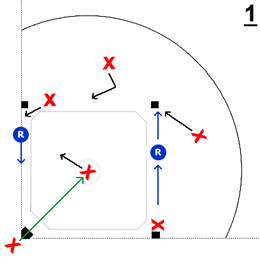
Pitcher Cut |
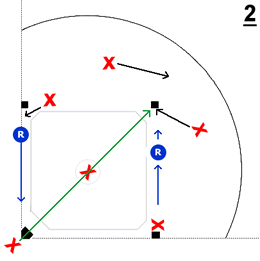
Throw Through |
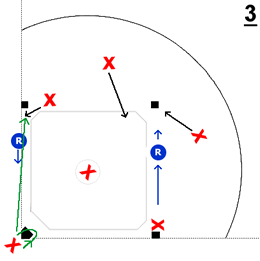
Fake 2nd Throw 3rd |
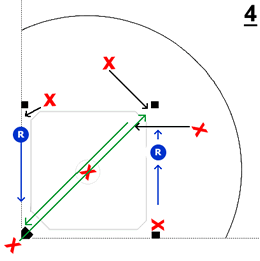
Double Cut |
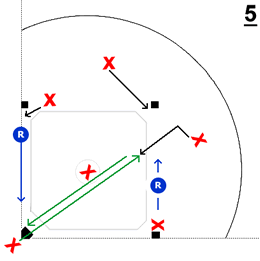
Charge |
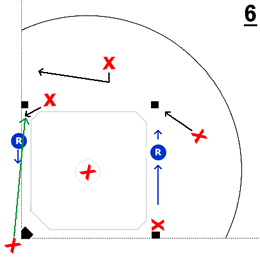
Snap Throw 3B |
In double-steal situations, every player on the field should look and listen for the defensive signal. Outfielders must be alert to move quickly to back up positions. We want to be sure that two runs are never scored against us because of an errant throw or a misplay in the infield. When the runner on first breaks for second, the first baseman always alerts the catcher with a big shout, "going." In some instances, we may instruct the first baseman to trail the runner going to second to thwart the delayed steal manuever.
Double-Steal Defensive Play Highlights |
||
Number |
Name |
Description |
|
1 |
Pitcher Cut |
Catcher aims for pitcher's cap and throws toward 2nd base. Pitcher cuts off the throw, and he either relays a quick throw to 3rd base, or runs at the base runner to force a rundown. |
|
2 |
Throw Through |
Catcher throws down to 2nd. Faking to cutoff the throw, the pitcher slaps his hand into his glove attempting to freeze the runner's movement at third. If the 3rd base runner breaks for home, the infielder relays the throw back home. If 3rd base runner stays put, the infielder tags the runner sliding into 2nd. |
|
3 |
Fake 2B/Throw 3B |
To draw the runner away from the 3rd base, the catcher makes a realistic fake throw toward 2nd. For the play to be effective, the catcher must sell the fake to the runner at third base. The pitcher also fakes, like he's ducking or dodging the throw. Catcher fires promptly to 3rd. |
|
4 |
Double Cut |
With a RH batter, the SS covers 2nd base and the 2B is the cut-off man. The 2B runs to halfway between the mound and 2nd base. Faking to cutoff the throw, the pitcher slaps his hand into his glove attempting to freeze the runner's movement at third. If the runner at 3rd breaks for home, the 2B cuts off the throw and returns it to the catcher. Otherwise, he lets the throw go through. |
|
5 |
Charge |
As soon as the pitcher delivers the pitch, the 2B charges directly toward home plate. The catcher throws to the onrushing 2B who either returns a throw to the catcher or to 3rd base. |
|
6 |
Snap Throw 3B |
Catcher receives the pitch and immediately throws to 3rd base. This play is more common with a left-handed hitter at the plate. |